






At-A-Glance: World Cup Facts Every Beginner Should Know
- The 2026 FIFA World Cup is the biggest in history — 48 teams across Canada, Mexico, and the USA from June 11 to July 19
- Brazil is the only nation to have qualified for every single World Cup since the tournament began in 1930
- You don’t need to understand soccer to enjoy the World Cup — the drama, culture, and atmosphere make it unmissable even for total beginners
- The tournament runs on a group stage and knockout format that’s surprisingly easy to follow once you know the basics
- Keep reading to find out which underdog nations have pulled off the biggest upsets in World Cup history — the answers might shock you
The World Cup doesn’t just attract soccer fans — it stops the entire planet.
Whether you’ve never watched a soccer match in your life or you’re just starting to get curious, the FIFA World Cup is one of those events that pulls you in regardless of your sporting background. The sheer scale of it, the passion from fans across every continent, and the stories that unfold on the pitch make it genuinely impossible to ignore. If you’re looking for a solid starting point, Roadtrips.com is a great resource for World Cup travel packages and tournament guides that help newcomers get up to speed fast.
The 2026 edition is the perfect entry point, too. It’s the largest World Cup ever organized, packed with new teams, new cities, and a whole new format. This guide will walk you through everything you need to know — no prior soccer knowledge required.
The World Cup Is Bigger Than You Think
Most people underestimate just how massive this tournament is. The Super Bowl draws around 100 million viewers. The World Cup final? It pulled in an estimated 1.5 billion people for the 2022 match between Argentina and France. That’s not a typo — roughly one in five people on Earth watched that single game.
The FIFA World Cup is held every four years and brings together national teams from across the globe to compete for one title: World Champion. It’s not a club competition like the UEFA Champions League where teams like Real Madrid or Manchester City play. This is country vs. country, which makes every match feel like something far bigger than a regular game.
Quick Comparison: World Cup vs. Other Major Sporting Events
Event Teams/Athletes Global Viewership (approx.) FIFA World Cup Final 2022 2 national teams 1.5 billion Super Bowl LVIII (2024) 2 NFL teams ~200 million Summer Olympics 2024 206 nations ~3 billion (entire event) NBA Finals 2023 2 NBA teams ~50 million
Why the World Cup Happens Only Every Four Years
The four-year cycle isn’t random. FIFA introduced this schedule back when the first World Cup launched in 1930 in Uruguay, partly for logistical reasons — international travel was slow, organizing a global tournament took years of planning, and national teams needed time to prepare qualifying campaigns. Today, the format remains the same because it preserves the prestige. Rarity makes it matter more.
2026 Is the Biggest World Cup Ever — Here’s Why
Every World Cup from 1998 through 2022 featured 32 national teams. The 2026 edition breaks that mold entirely. For the first time in history, 48 teams will compete across the tournament, meaning 16 additional nations get their shot at the world stage.
The expansion also means a jump from 64 total matches to 104 matches across the tournament. More games, more drama, more chances for upsets. And the host setup is completely unique — the matches will be spread across three countries simultaneously: the United States, Canada, and Mexico.
2026 World Cup Host Cities at a Glance
Country Host Cities United States New York/New Jersey, Los Angeles, Dallas, San Francisco, Miami, Seattle, Boston, Kansas City, Philadelphia, Atlanta Canada Toronto, Vancouver Mexico Mexico City, Guadalajara, Monterrey
How the World Cup Actually Works
The structure of the tournament is easier to follow than most people assume. It’s split into two main phases: the Group Stage and the Knockout Rounds. Once you understand those two phases, the whole thing clicks.
Think of it like a school sports day that gets progressively more intense. In the early rounds, every team gets multiple chances. But once the knockout stage begins, one loss and you’re on a plane home. That pressure is exactly what makes the later rounds so electric to watch.
48 Teams, 6 Continents: How Countries Qualify
Before a single ball is kicked at the World Cup itself, teams from around the world spend years competing in regional qualifying matches just to earn a spot. For the 2026 tournament, a massive 211 national teams entered the qualification process. Only 48 made it through.
FIFA divides the world into six continental confederations, and each region gets an allocated number of qualifying spots based roughly on the strength and size of soccer in that region:
- UEFA (Europe): 16 spots
- CAF (Africa): 9 spots
- CONMEBOL (South America): 6 spots
- AFC (Asia): 8 spots
- CONCACAF (North/Central America & Caribbean): 6 spots
- OFC (Oceania): 1 spot
- Inter-confederation playoffs: 2 spots
This matters for beginners because it explains why you’ll see teams from tiny island nations or first-time qualifiers sharing a stage with giants like Germany or Brazil. That mix of experience levels is part of what makes the group stage so unpredictable.
Group Stage vs. Knockout Rounds Explained Simply
In the 2026 Group Stage, all 48 teams are divided into 12 groups of 4 teams each. Every team plays the other three teams in their group once. The top two teams from each group, plus the eight best third-place finishers, advance to the Round of 32 — which is a new addition for 2026.
2026 World Cup Tournament Format
Stage Teams Remaining How It Works Group Stage 48 12 groups of 4; top 2 + 8 best 3rd-place teams advance Round of 32 32 Single elimination begins Round of 16 16 Single elimination continues Quarterfinals 8 Single elimination Semifinals 4 Single elimination Third Place Match 2 Losers of semifinals compete Final 2 Winner becomes World Champion
From the Round of 32 onward, it’s pure knockout soccer. Win or go home. No second chances, no standings to fall back on.
What Happens When a Game Ends in a Tie
In the Group Stage, a tie (called a draw) is a valid result — both teams earn one point. But in the knockout rounds, there must be a winner. If a match is level after 90 minutes, the game goes into extra time: two additional 15-minute periods. If it’s still tied after that, the match is decided by a penalty shootout — one of the most nerve-wracking moments in all of sports.
A penalty shootout comes down to five players from each team taking turns shooting from 12 yards out against the opposing goalkeeper. It’s essentially a coin flip with skill attached, which is why even the most seasoned fans watch through their fingers.
Records and Facts That Will Surprise You
Brazil Has Never Missed a Single World Cup
Out of every nation on Earth, only one has qualified for all 22 World Cups ever held — Brazil. Not Germany. Not Argentina. Not Italy. Brazil alone holds that record, and it speaks to just how deeply embedded soccer is in the country’s identity. In Brazil, soccer isn’t just a sport. It’s a national religion, and the World Cup is its holiest event.
The Highest-Scoring Match in World Cup History Was 12 Goals
In 1954, Austria and Switzerland played out the most chaotic match in World Cup history, with Austria winning 7-5 — a combined 12 goals in a single game. For context, most World Cup matches finish 1-0 or 2-1. A 7-5 scoreline is almost unheard of at this level, which makes the 1954 quarterfinal genuinely one of a kind.
Even more remarkable is that this match happened in the knockout stage, where the pressure is supposed to tighten defenses. Instead, both goalkeepers had one of the worst afternoons in World Cup history, and fans at Lausanne’s Hardturm Stadium witnessed something that has never been repeated since.
The World Cup Has Been Played 22 Times Since 1930
The first ever FIFA World Cup took place in Uruguay in 1930, with just 13 teams competing. Uruguay won on home soil, defeating Argentina 4-2 in the final. The tournament was a modest event by today’s standards, but it planted the seed for what would become the biggest sporting spectacle on Earth.
Two editions were cancelled — 1942 and 1946 — due to World War II. Every other edition has gone ahead on schedule since 1930, making the World Cup one of the most consistent major sporting events in modern history. The 2026 edition will mark the 23rd World Cup tournament.
Here’s a quick look at the countries that have won the World Cup across all 22 tournaments:
| Country | World Cup Wins | Years Won |
|---|---|---|
| Brazil | 5 | 1958, 1962, 1970, 1994, 2002 |
| Germany | 4 | 1954, 1974, 1990, 2014 |
| Italy | 4 | 1934, 1938, 1982, 2006 |
| Argentina | 3 | 1978, 1986, 2022 |
| France | 2 | 1998, 2018 |
| Uruguay | 2 | 1930, 1950 |
| England | 1 | 1966 |
| Spain | 1 | 2010 |
Teams Worth Watching in 2026
Even if you don’t follow club soccer, knowing a few key national teams going into the 2026 tournament gives the whole experience a different energy. You start caring about results, tracking group standings, and suddenly you’re hooked. That’s how the World Cup works on people — even the most casual observers.
The easiest way to pick a team to follow is to go with your home country if they’ve qualified, or pick a nation with a compelling story going into the tournament. Both strategies work perfectly for beginners.
Brazil, Germany, and Argentina: The Usual Powerhouses
These three nations have a combined 12 World Cup titles between them. Brazil brings the most technically gifted players on the planet, playing a style of soccer that’s genuinely beautiful to watch even if you know nothing about tactics. Germany are relentlessly efficient — they rarely dazzle, but they almost always find a way to win. Argentina, fresh off their emotional 2022 World Cup victory in Qatar, will be defending their title with a squad still riding that momentum, even as the legendary Lionel Messi enters what is likely his final World Cup campaign.
Underdog Nations That Have Shocked the World Before
The World Cup’s greatest moments don’t always come from the powerhouses. Some of the tournament’s most iconic upsets have come from nations nobody expected to compete at that level. In 2002, South Korea reached the semifinals as co-hosts — knocking out both Spain and Germany along the way. In 2018, Iceland, a nation of just 330,000 people, held Argentina to a draw in the group stage. In 2022, Morocco became the first African nation to reach the semifinals, defeating Belgium, Spain, and Portugal in succession.
These stories are exactly why the expanded 48-team format in 2026 is so exciting for newcomers. More teams means more room for first-time qualifiers and smaller nations to make history. Don’t sleep on countries like Japan, Senegal, or even the USA on home soil — all three have the squad depth to cause serious problems for any opponent.
World Cup 2026: Canada, Mexico, and the USA as Hosts
The 2026 World Cup is genuinely unprecedented in its setup. For the first time ever, three countries will co-host the tournament simultaneously. Games will be played in 16 cities spanning three nations, creating a travel and fan experience unlike anything the tournament has ever seen before.
The United States will host the lion’s share of the matches, including the World Cup Final at MetLife Stadium in East Rutherford, New Jersey — one of the largest stadiums in North America. Mexico City’s iconic Estadio Azteca will also be a host venue, making it the first stadium in history to host World Cup matches in three different tournaments (1970, 1986, and 2026).
Host Cities Across Three Countries
Spread across the continent, the host cities offer an extraordinary range of experiences for fans attending in person. From the energy of New York to the altitude of Mexico City to the coastal cool of Vancouver, the 2026 World Cup is essentially a continent-wide festival that runs for over five weeks.
For fans watching from home, the geographic spread does create one practical consideration — game times will vary depending on which city is hosting. Early group stage matches could kick off as early as noon local time, while others in different time zones may run into late evening. Checking a World Cup schedule app closer to the tournament will help you plan which games to follow live.
June 11 to July 19: How to Follow Along Without Missing a Moment
The tournament runs for 39 days, from the opening match on June 11 all the way through to the World Cup Final on July 19, 2026. During the group stage, multiple games happen simultaneously every day, so there’s almost always something on. Fox Sports and Telemundo have the broadcast rights in the United States, with streaming options available through their respective platforms. For more information on the event, check out the World Cup Ultimate Guide.
Soccer Culture That Makes the World Cup Unique
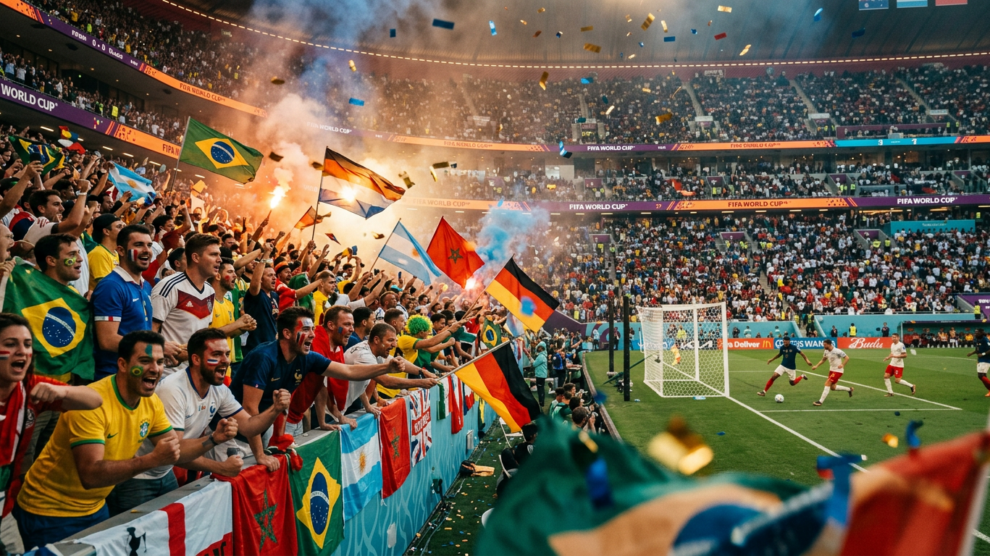
The actual matches are just one layer of what makes the World Cup special. The culture surrounding the tournament — the chants, the colors, the fan zones, the national pride on display — creates an atmosphere that no other sporting event can fully replicate. Walking through a host city during the World Cup feels like every country on Earth decided to hold a street party at the same time.
Every nation brings its own traditions to the tournament. Brazilian fans fill stadiums with drumbeats and yellow and green. Mexican supporters make the ground shake with their iconic “¡El Tri!” chant. English fans belt out “Three Lions” with a mixture of hope and heartbreak that only decades of near-misses can produce. Even if you have no team loyalty going in, you’ll find yourself drawn into the energy of a crowd that genuinely believes their country’s moment has finally arrived. For more insights, check out this World Cup ultimate guide.
Fan Chants, Jerseys, and Traditions From Around the World
Walk into any World Cup host city during a match day and the first thing that hits you isn’t the soccer — it’s the sound. Thousands of fans in replica jerseys, faces painted in national colors, singing songs that their grandparents sang before them. The Argentinian “Muchachos” chant that swept through Qatar in 2022 became a global phenomenon almost overnight. Mexican fans bring enormous paper-mâché figures and coordinated crowd waves. Japanese supporters are famous worldwide for cleaning up their section of the stadium after every match — win or lose.
Jerseys deserve their own mention. Every World Cup cycle produces iconic kits that become collector’s items. The 1970 Brazil yellow, the 1998 France blue, the 2010 Germany white — these shirts carry decades of history stitched into them. Wearing your national team’s jersey to a watch party or fan zone is an instant conversation starter, even if you’ve never followed soccer before in your life.
Why Soccer Connects Cultures Like No Other Sport
Soccer is played in every country on Earth. No other sport comes close to that kind of universal reach. You can drop a ball in a village with no electricity, no stadium, and no formal pitch, and within minutes there’ll be a game going. That shared foundation — the simplicity of the game — is what makes the World Cup feel like a genuinely global moment rather than a regional sporting event dressed up in big numbers.
The 2026 World Cup being hosted across three countries amplifies this even further. North America alone is home to hundreds of immigrant communities from every soccer-passionate nation on the planet. When Nigeria plays, Nigerian communities in Houston will be watching together. When Portugal plays, Portuguese neighborhoods in Toronto will feel it. The World Cup has a unique way of making people feel simultaneously at home and part of something much larger than themselves.
The World Cup Is Worth Watching, Even If You Don’t Know Soccer
You don’t need to understand the offside rule to feel the tension of a penalty shootout. You don’t need to know formation tactics to appreciate a 30-yard screamer hitting the back of the net. The World Cup works on a purely emotional level — the stakes are obvious, the passion is visible, and the stories write themselves. From veteran stars chasing a final shot at glory to tiny nations competing on the world stage for the very first time, the 2026 FIFA World Cup will deliver moments that go far beyond the sport itself. Tune in, even once, and see what happens.
Frequently Asked Questions
If you’re new to the World Cup, a few quick answers to the most common beginner questions will help you feel confident heading into 2026.
How Many Teams Play in the 2026 World Cup?
The 2026 FIFA World Cup will feature 48 national teams — the largest field in World Cup history. Previously, 32 teams competed from 1998 through 2022. The expansion adds 16 new nations and pushes the total number of matches from 64 to 104 games across the tournament.
Which Country Has Won the Most World Cups?
Brazil has won the most World Cups with 5 titles — 1958, 1962, 1970, 1994, and 2002. No other nation has reached that number. Germany and Italy each have 4 titles, while Argentina claimed their third in 2022 under Lionel Messi.
Brazil’s dominance isn’t just about trophies, either. The way Brazil plays — technically precise, expressive, and built around individual flair — has shaped how the entire world thinks about soccer. Players like Pelé, Ronaldo, Ronaldinho, and Neymar all wore the famous yellow jersey and left permanent marks on the game.
What makes Brazil’s record even more extraordinary is the consistency. While other powerhouses like Italy have missed tournaments entirely — Italy failed to qualify for both 2018 and the 2022 World Cups — Brazil has never once missed a single edition since 1930. That’s 22 consecutive qualifications across nearly a century of competition.
For 2026, Brazil will be looking to reclaim the title they last won in 2002 with a new generation of talent. Their combination of youth, technical ability, and tournament experience makes them one of the favorites heading into the North American edition.
Countries With the Most World Cup Titles
Rank Country Titles Most Recent Win 1 Brazil 5 2002 2 Germany 4 2014 2 Italy 4 2006 4 Argentina 3 2022 5 France 2 2018 5 Uruguay 2 1950
Where Is the 2026 World Cup Being Held?
The 2026 FIFA World Cup is being hosted jointly by the United States, Canada, and Mexico — the first time three countries have ever co-hosted the tournament. Matches will be played across 16 cities, with the World Cup Final taking place at MetLife Stadium in East Rutherford, New Jersey. The tournament runs from June 11 to July 19, 2026. For more details, check out this World Cup Ultimate Guide.
How Long Does the World Cup Tournament Last?
The 2026 World Cup runs for 39 days, from opening match to the final. During the group stage, fans can watch multiple games per day as all 48 teams work through their group fixtures. The knockout rounds then narrow the field down week by week until just two teams remain for the final on July 19th. For a beginner, the best strategy is to follow the group stage casually and then lock in for the quarterfinals onward — that’s where the intensity becomes genuinely unmissable.
Do You Need to Know Soccer Rules to Enjoy the World Cup?
Not really. The core of soccer is simple — put the ball in the net more times than the other team. That’s genuinely all you need to follow 90% of what happens on the pitch. The more nuanced rules like offside, handball decisions, and VAR (Video Assistant Referee) reviews will make more sense over time, but they don’t stop you from feeling every goal, every save, and every near-miss in real time.
The three rules worth knowing as a beginner are: a goal only counts if the whole ball crosses the line, players cannot use their hands or arms to play the ball (except the goalkeeper inside their box), and a yellow card is a warning while a red card means the player is sent off and their team plays with one fewer person for the rest of the match.