








Few nations in modern history have undergone a transformation as dramatic — and as misunderstood — as Iran before and after 1979.
To truly grasp what the Islamic Revolution changed, you first have to understand what it replaced. In the 1960s and 1970s, Iran was not the isolated, theocratic state the world knows today. It was a country racing toward modernization, flush with oil wealth, building universities, sending women to parliament, and positioning itself as the dominant power of the Middle East. The contrast with what came after is stark — and deeply important for anyone trying to understand the region’s history.
Key Takeaways: Life in Iran Before the Islamic Republic
- Iran under the Shah was a rapidly modernizing country with one of the strongest economies in the developing world during the 1960s–70s.
- Women held legal protections, voting rights, and professional freedoms that were reversed after 1979.
- The oil boom of 1973 transformed Iran’s ambitions but also deepened inequality and social tension.
- Political repression under SAVAK created the conditions for revolution even as Iran prospered economically.
- The cultural clash between Western-influenced modernization and deep-rooted Iranian and Islamic identity was the revolution’s true fuel.
Iran Was Once One of the World’s Most Modernizing Nations
In the 1960s and 1970s, Iran was the kind of country that economists and diplomats pointed to as proof that modernization theory worked. Under Shah Mohammad Reza Pahlavi, Iran built highways, launched a nuclear program, expanded its military into one of the most powerful in the world, and positioned Tehran as a cosmopolitan city that blended Persian heritage with modern ambition.
This wasn’t a slow, organic process — it was a deliberate, top-down push driven by the Shah’s vision of what he called the Great Civilization. Ali Ansari, writing in Modern Iran: Reform and Revolution: The Pahlavis and After, describes how the oil boom largely orchestrated by the Shah at the end of 1973 appeared to catapult Iran into the premier league of nations, with a growing industrial base, a generous welfare system, highly developed armed forces, and a nuclear programme that was the envy of many.
Iran was not simply copying the West. It was a non-Arab country with a rich historical heritage, universalist ambitions, and a political economy that both empowered and enabled it. That context matters enormously when trying to understand the revolution that followed.
The Shah’s Vision: Iran’s Path to a “Great Civilization”
Shah Mohammad Reza Pahlavi wasn’t just interested in modernizing Iran — he wanted to restore it to the global stage as a civilization-level power. His ambitions were enormous, and for a time, the resources to fund them were too. To understand more about the impact of these ambitions, you can explore how the 1979 revolution changed the world.
- Iran developed a civilian nuclear energy program with Western cooperation in the 1970s.
- The Iranian military was equipped with advanced American weaponry, making it among the best-equipped forces outside of NATO.
- A national welfare system provided healthcare and subsidies to rural and urban populations.
- Massive infrastructure projects — roads, dams, and industrial plants — reshaped the physical landscape of the country.
- Iran cultivated diplomatic ties with both Western powers and regional neighbors, projecting itself as a stabilizing force in the Persian Gulf.
The Shah’s cultural outlook was firmly anchored to the West. As Ansari notes, although Iran’s emergence into the modern world put Tehran in a fractious relationship with Western powers, Iran’s cultural ambitions remained closely tied to Western models of development. Russia — and later the Soviet Union — was admired but feared. The United States was Iran’s most important strategic partner.
The White Revolution and Its Sweeping Reforms
In January 1963, the Shah launched what he called the White Revolution — a top-down reform program designed to modernize Iranian society without the chaos of a political revolution. The reforms included land redistribution, the nationalization of forests, profit-sharing for factory workers, women’s suffrage, and a literacy corps that sent educated young Iranians into rural villages to teach reading and writing. For a deeper understanding of how these reforms impacted Iran, you can read about Iran’s revolution and its global impact.
These were not modest changes. Land reform alone dismantled the feudal landholding system that had defined rural Iran for centuries, transferring ownership to millions of peasant farmers. Women gaining the right to vote was a seismic cultural shift in a society where clerical influence over gender roles was deeply entrenched. The White Revolution’s ambitions were real — and so was the resistance it generated, particularly from the religious establishment.
Iran’s Oil Wealth and Industrial Ambitions
Oil was the engine of everything. Iran had been a significant oil producer since the early 20th century, but it was the nationalization of the oil industry under Prime Minister Mohammad Mosaddegh in 1951 — and its complicated aftermath — that set the stage for the Shah’s eventual control over oil revenues. By the early 1970s, those revenues were transforming the country at an unprecedented pace.
- Iran’s GDP growth was among the highest in the developing world through the late 1960s and early 1970s.
- The country invested heavily in steel, petrochemicals, and manufacturing to diversify beyond raw oil exports.
- Tehran became a hub of international business, with Western corporations establishing major operations in the country.
- Agricultural subsidies and rural development programs were funded through oil revenues.
The 1973 OPEC oil embargo — which the Shah actively supported — quadrupled global oil prices almost overnight, flooding Iran’s treasury with unprecedented wealth. The Shah famously used this windfall to accelerate his industrial ambitions. But as we’ll see, the pace of that acceleration created its own set of serious problems.
How Iran’s Military Power Rivaled Regional Superpowers
By the mid-1970s, Iran had one of the most powerful conventional military forces outside of the NATO alliance. The Shah spent lavishly on American and British military hardware — F-14 Tomcat fighter jets, destroyers, and advanced missile systems. Iran’s military budget ballooned after 1973, with the country becoming one of the United States’ most important arms customers.
This wasn’t just about external defense. The Shah saw a powerful military as essential to Iran’s regional dominance — a way of asserting Iran’s role as the undisputed power of the Persian Gulf after Britain withdrew from the region in 1971. The United States, eager for a stable pro-Western partner in an oil-rich and strategically vital region, actively supported this buildup.
The military’s size and sophistication created an image of unshakeable stability. Right up until late 1978, many Western analysts and diplomats genuinely believed the Shah’s regime was secure. That miscalculation would prove to be one of the most consequential intelligence failures of the 20th century. For a deeper understanding of this pivotal time, explore how Iran’s revolution in 1979 changed the world.
Daily Life in Pre-Revolutionary Iran
Behind the geopolitical story was real, textured daily life — and for many Iranians, particularly in urban areas, the 1960s and 1970s were years of genuine opportunity, cultural energy, and growing prosperity.
What Tehran Looked Like in the 1960s and 1970s
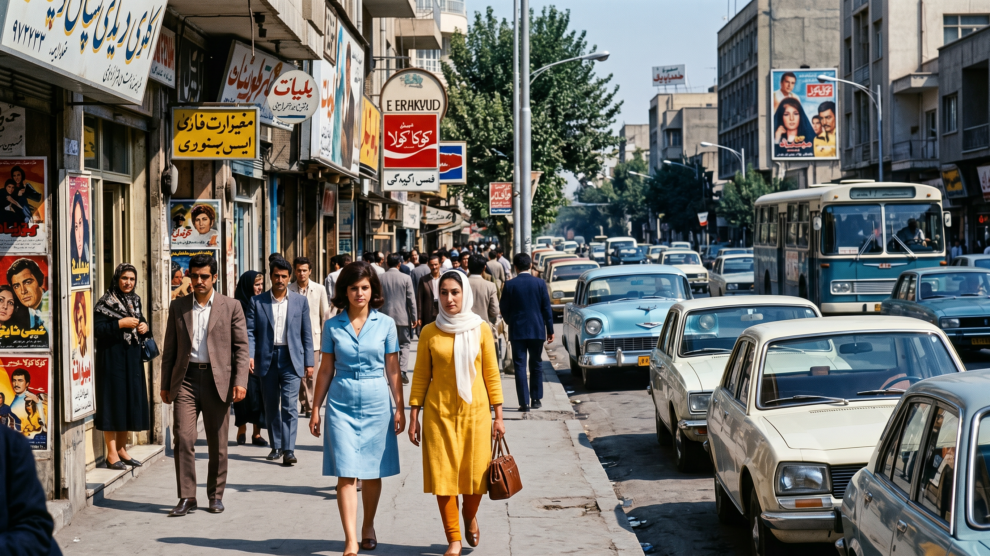
Tehran in this era was a genuinely cosmopolitan city. Wide modern boulevards ran alongside ancient bazaars. International hotels hosted Western businesspeople and tourists. Restaurants, cinemas, and nightclubs operated openly. Women walked the streets without mandatory head coverings. The city’s population surged as rural Iranians migrated in search of economic opportunity, transforming Tehran into a sprawling, dynamic — and increasingly unequal — metropolis.
The physical contrast between the wealthy northern neighborhoods of Tehran and the poorer southern districts reflected a broader national divide. The oil boom had created a visible, Westernized upper class whose lifestyle bore little resemblance to the lives of working-class Iranians or the rural poor. That gap would become politically explosive.
The Rise of a Western-Influenced Middle Class
Iran’s expanding economy created a significant middle class — engineers, doctors, teachers, bureaucrats, and small business owners — who benefited directly from the Shah’s modernization programs. Many sent their children to university in Europe or the United States. Western consumer goods, fashion, and music became markers of status and aspiration in urban Iran.
But this Westernization was also a source of profound anxiety. For many Iranians — including educated ones — the speed and superficiality of cultural change felt like an erasure of Iranian identity rather than an enrichment of it. The philosopher Ali Shariati captured this tension powerfully, arguing that Iranians were becoming culturally hollow — imitating the West while losing touch with their own heritage.
This identity crisis cut across class lines. Even some of the most educated and privileged Iranians felt that the Shah’s modernization was being imposed from above rather than grown from within — and that it came at the cost of authentic Iranian and Islamic culture.
- Pre-revolutionary Iran was one of the fastest-modernizing nations of the 20th century, with a booming oil economy, a growing middle class, and ambitious infrastructure development under Shah Mohammad Reza Pahlavi.
- Women in Iran had significant legal rights before 1979, including the right to vote, pursue higher education, and work in government — rights that were dramatically curtailed after the Islamic Revolution.
- Despite its modern image, the Shah’s regime ran one of the most feared secret police organizations in the world — SAVAK — which suppressed political dissent and fueled deep resentment among ordinary Iranians.
- The 1973 oil boom accelerated Iran’s ambitions, but also widened economic inequality and created a cultural identity crisis that would ultimately help bring the regime down.
- The revolution was not inevitable — understanding what daily life actually looked like before 1979 reveals just how complex, contradictory, and ultimately fragile the Pahlavi era really was.
Few nations in modern history have undergone a transformation as dramatic — and as misunderstood — as Iran before and after 1979.
To truly grasp what the Islamic Revolution changed, you first have to understand what it replaced. In the 1960s and 1970s, Iran was not the isolated, theocratic state the world knows today. It was a country racing toward modernization, flush with oil wealth, building universities, sending women to parliament, and positioning itself as the dominant power of the Middle East. The contrast with what came after is stark — and deeply important for anyone trying to understand the region’s history.
Key Takeaways: Life in Iran Before the Islamic Republic
- Iran under the Shah was a rapidly modernizing country with one of the strongest economies in the developing world during the 1960s–70s.
- Women held legal protections, voting rights, and professional freedoms that were reversed after 1979.
- The oil boom of 1973 transformed Iran’s ambitions but also deepened inequality and social tension.
- Political repression under SAVAK created the conditions for revolution even as Iran prospered economically.
- The cultural clash between Western-influenced modernization and deep-rooted Iranian and Islamic identity was the revolution’s true fuel.
Iran Was Once One of the World’s Most Modernizing Nations
In the 1960s and 1970s, Iran was the kind of country that economists and diplomats pointed to as proof that modernization theory worked. Under Shah Mohammad Reza Pahlavi, Iran built highways, launched a nuclear program, expanded its military into one of the most powerful in the world, and positioned Tehran as a cosmopolitan city that blended Persian heritage with modern ambition.
This wasn’t a slow, organic process — it was a deliberate, top-down push driven by the Shah’s vision of what he called the Great Civilization. Ali Ansari, writing in Modern Iran: Reform and Revolution: The Pahlavis and After, describes how the oil boom largely orchestrated by the Shah at the end of 1973 appeared to catapult Iran into the premier league of nations, with a growing industrial base, a generous welfare system, highly developed armed forces, and a nuclear programme that was the envy of many.
Iran was not simply copying the West. It was a non-Arab country with a rich historical heritage, universalist ambitions, and a political economy that both empowered and enabled it. That context matters enormously when trying to understand the revolution that followed.
The Shah’s Vision: Iran’s Path to a “Great Civilization”
Shah Mohammad Reza Pahlavi wasn’t just interested in modernizing Iran — he wanted to restore it to the global stage as a civilization-level power. His ambitions were enormous, and for a time, the resources to fund them were too. To understand more about the impact of these ambitions, you can explore how the 1979 revolution changed the world.
- Iran developed a civilian nuclear energy program with Western cooperation in the 1970s.
- The Iranian military was equipped with advanced American weaponry, making it among the best-equipped forces outside of NATO.
- A national welfare system provided healthcare and subsidies to rural and urban populations.
- Massive infrastructure projects — roads, dams, and industrial plants — reshaped the physical landscape of the country.
- Iran cultivated diplomatic ties with both Western powers and regional neighbors, projecting itself as a stabilizing force in the Persian Gulf.
The Shah’s cultural outlook was firmly anchored to the West. As Ansari notes, although Iran’s emergence into the modern world put Tehran in a fractious relationship with Western powers, Iran’s cultural ambitions remained closely tied to Western models of development. Russia — and later the Soviet Union — was admired but feared. The United States was Iran’s most important strategic partner.
The White Revolution and Its Sweeping Reforms
In January 1963, the Shah launched what he called the White Revolution — a top-down reform program designed to modernize Iranian society without the chaos of a political revolution. The reforms included land redistribution, the nationalization of forests, profit-sharing for factory workers, women’s suffrage, and a literacy corps that sent educated young Iranians into rural villages to teach reading and writing. For a deeper understanding of how these reforms impacted Iran, you can read about Iran’s revolution and its global impact.
These were not modest changes. Land reform alone dismantled the feudal landholding system that had defined rural Iran for centuries, transferring ownership to millions of peasant farmers. Women gaining the right to vote was a seismic cultural shift in a society where clerical influence over gender roles was deeply entrenched. The White Revolution’s ambitions were real — and so was the resistance it generated, particularly from the religious establishment.
Iran’s Oil Wealth and Industrial Ambitions
Oil was the engine of everything. Iran had been a significant oil producer since the early 20th century, but it was the nationalization of the oil industry under Prime Minister Mohammad Mosaddegh in 1951 — and its complicated aftermath — that set the stage for the Shah’s eventual control over oil revenues. By the early 1970s, those revenues were transforming the country at an unprecedented pace.
- Iran’s GDP growth was among the highest in the developing world through the late 1960s and early 1970s.
- The country invested heavily in steel, petrochemicals, and manufacturing to diversify beyond raw oil exports.
- Tehran became a hub of international business, with Western corporations establishing major operations in the country.
- Agricultural subsidies and rural development programs were funded through oil revenues.
The 1973 OPEC oil embargo — which the Shah actively supported — quadrupled global oil prices almost overnight, flooding Iran’s treasury with unprecedented wealth. The Shah famously used this windfall to accelerate his industrial ambitions. But as we’ll see, the pace of that acceleration created its own set of serious problems.
How Iran’s Military Power Rivaled Regional Superpowers
By the mid-1970s, Iran had one of the most powerful conventional military forces outside of the NATO alliance. The Shah spent lavishly on American and British military hardware — F-14 Tomcat fighter jets, destroyers, and advanced missile systems. Iran’s military budget ballooned after 1973, with the country becoming one of the United States’ most important arms customers.
This wasn’t just about external defense. The Shah saw a powerful military as essential to Iran’s regional dominance — a way of asserting Iran’s role as the undisputed power of the Persian Gulf after Britain withdrew from the region in 1971. The United States, eager for a stable pro-Western partner in an oil-rich and strategically vital region, actively supported this buildup.
The military’s size and sophistication created an image of unshakeable stability. Right up until late 1978, many Western analysts and diplomats genuinely believed the Shah’s regime was secure. That miscalculation would prove to be one of the most consequential intelligence failures of the 20th century. For a deeper understanding of this pivotal time, explore how Iran’s revolution in 1979 changed the world.
Daily Life in Pre-Revolutionary Iran
Behind the geopolitical story was real, textured daily life — and for many Iranians, particularly in urban areas, the 1960s and 1970s were years of genuine opportunity, cultural energy, and growing prosperity.
What Tehran Looked Like in the 1960s and 1970s
Tehran in this era was a genuinely cosmopolitan city. Wide modern boulevards ran alongside ancient bazaars. International hotels hosted Western businesspeople and tourists. Restaurants, cinemas, and nightclubs operated openly. Women walked the streets without mandatory head coverings. The city’s population surged as rural Iranians migrated in search of economic opportunity, transforming Tehran into a sprawling, dynamic — and increasingly unequal — metropolis.
The physical contrast between the wealthy northern neighborhoods of Tehran and the poorer southern districts reflected a broader national divide. The oil boom had created a visible, Westernized upper class whose lifestyle bore little resemblance to the lives of working-class Iranians or the rural poor. That gap would become politically explosive.
The Rise of a Western-Influenced Middle Class
Iran’s expanding economy created a significant middle class — engineers, doctors, teachers, bureaucrats, and small business owners — who benefited directly from the Shah’s modernization programs. Many sent their children to university in Europe or the United States. Western consumer goods, fashion, and music became markers of status and aspiration in urban Iran.
But this Westernization was also a source of profound anxiety. For many Iranians — including educated ones — the speed and superficiality of cultural change felt like an erasure of Iranian identity rather than an enrichment of it. The philosopher Ali Shariati captured this tension powerfully, arguing that Iranians were becoming culturally hollow — imitating the West while losing touch with their own heritage.
This identity crisis cut across class lines. Even some of the most educated and privileged Iranians felt that the Shah’s modernization was being imposed from above rather than grown from within — and that it came at the cost of authentic Iranian and Islamic culture.