








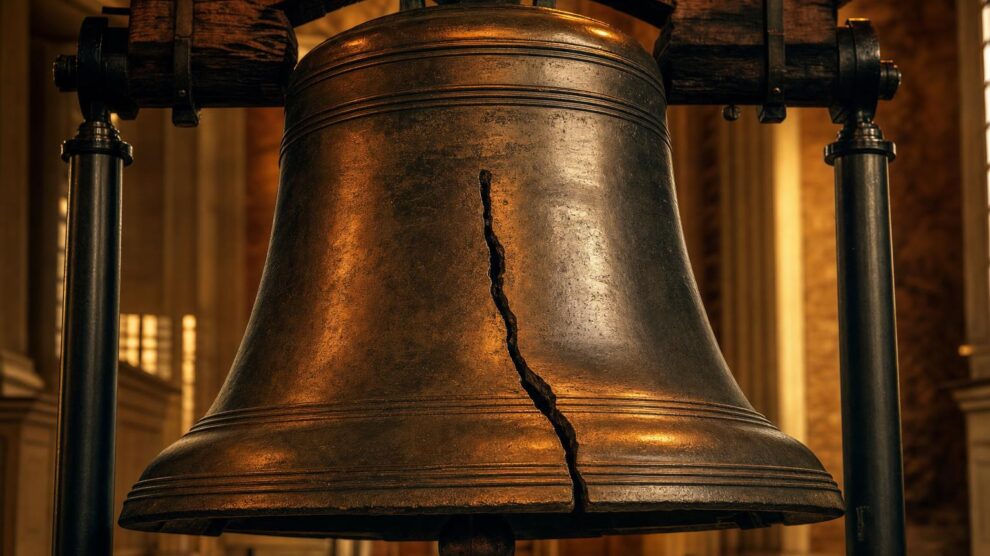
- The Liberty Bell’s famous crack is actually the result of a botched repair job from 1846, not a single dramatic event.
- The bell was already fragile from the start, cracking during its very first test ring in 1752 after arriving from London.
- No one officially recorded when the original crack first appeared, making it one of American history’s most debated mysteries.
- The wide “crack” you see today contains over 40 drill marks from a stop-drilling repair attempt that ultimately failed.
- Keep reading to find out which popular legends about the crack are completely false — including one about a famous Chief Justice’s funeral.
One of America’s most iconic symbols is famous specifically because it’s broken — and the real story of how it got that way is far more complicated than most people realize.
The Liberty Bell has been ringing through American history since 1753, calling lawmakers to session, marking deaths of founding fathers, and becoming a rallying symbol for abolitionists and suffragists alike. For history enthusiasts, understanding the full story behind the crack reveals just how much of what we think we know is wrapped in myth. What actually happened to this bell is a mix of metallurgical bad luck, decades of wear, and a repair attempt gone wrong.
Quick Facts: Why the Liberty Bell Cracked
Event Year Key Detail First crack on test strike 1752 Bell arrived from London’s Whitechapel Bell Foundry; cracked immediately Recast by Pass and Stow 1753 Philadelphia metalworkers melted and recast the bell twice Original hairline crack appears Early 1840s No official record; developed after ~90 years of use Stop-drilling repair attempt 1846 Workers drilled 40+ holes to widen crack and restore tone Second crack silences bell February 23, 1846 Bell rung for Washington’s Birthday; cracked beyond repair Relocated to Liberty Bell Center 2003 Now housed in Independence National Historic Park, Philadelphia
The Bell Was Already Flawed From the Start
Before the Liberty Bell ever rang freely over Philadelphia, it was already broken. The problems started not in America, but across the Atlantic — and they set the stage for everything that followed.
Cast in London, Cracked on Arrival
In the early 1750s, the Pennsylvania Provincial Assembly ordered a large bell for its new State House, later known as Independence Hall. They commissioned London’s Whitechapel Bell Foundry — one of the most respected bell makers in the world — to cast it, paying roughly 100 pounds for the job. The bell arrived in Philadelphia in August 1752 after crossing the Atlantic.
Almost immediately, disaster struck. During the very first test strike, the bell cracked. Historians believe the metal was simply too brittle, likely due to the bronze alloy being improperly balanced during casting. It never even had the chance to ring for an official occasion.
Recast Twice Before It Ever Rang Officially
Rather than ship the cracked bell back to London, Philadelphia turned to two local metalworkers: John Pass and John Stow. They melted down the original bell and recast it right there in the city. The first recast attempt produced a bell with a poor, tinny tone — mocked by those who heard it. Pass and Stow tried again, casting the bell a second time, and this version was finally accepted and hung in the State House steeple in 1753. It’s this bell — the second recast — that would go on to ring for nearly a century.
The Metal Composition That Made It Fragile
Traditional bells are made from bell metal, a specific alloy of approximately 80% copper and 20% tin. The Whitechapel original and the Pass and Stow recasts all worked within this general formula, but small variations in composition dramatically affect how brittle or resilient a bell becomes. A higher tin content increases hardness but reduces flexibility, making the metal far more prone to cracking under repeated stress. Given that the original bell cracked on first strike, and that the recasts eventually developed cracks too, metallurgists believe the alloy composition was slightly off from ideal proportions — a flaw baked into the bell’s very DNA from day one.
The Original Crack Nobody Recorded
Here’s where history gets genuinely murky. Despite being one of the most examined objects in American history, no one knows exactly when the Liberty Bell first developed its fateful crack during active service.
90 Years of Hard Use Before the Damage Showed
Between 1753 and the early 1840s, the Liberty Bell rang constantly. It tolled to call the Pennsylvania Assembly into session, marked the deaths of Benjamin Franklin and George Washington, and rang for the signing of the Constitution. That is nearly 90 years of repeated striking — and bell metal, however carefully cast, fatigues under that kind of sustained use. Micro-fractures form invisibly over time, spreading slowly through the metal until they become visible cracks. For more on this topic, you can explore stories of the Liberty Bell.
The most widely accepted explanation among historians is that a thin hairline crack gradually developed sometime in the early 1840s. By that point the bell had endured decades of regular use, seasonal temperature changes between Philadelphia winters and summers, and the cumulative stress of being a working instrument rather than a decorative one. No newspaper or city record officially documented the moment the crack appeared — it was simply noticed at some point and deemed a problem worth fixing.
- ~90 years of active ringing before visible cracking was noted
- Early 1840s is the most accepted window for when the hairline crack appeared
- No city record, newspaper account, or official document captures the exact date
- Temperature fluctuation in Philadelphia winters likely accelerated metal fatigue
- The bell was still being rung regularly right up until the failed 1846 repair
What’s remarkable is that the crack went undocumented for so long — a sign of just how casually the bell was treated as a working tool before it became a national symbol.
The Most Credible Theories Historians Argue About
Without an official record, historians have spent decades debating what actually caused the first significant crack. The leading theory centers on simple mechanical fatigue — the bell was rung so frequently, for so many decades, that the metal eventually gave way. A secondary theory points to a specific incident sometime in the early 1840s where the bell was rung for an extended period, perhaps during a celebration or public event, pushing the already-stressed metal past its breaking point. Neither theory has definitive proof, but the fatigue explanation aligns best with what metallurgists understand about bell metal behavior under prolonged use.
The 1846 Repair That Made Everything Worse
If the original crack is a mystery, the 1846 repair is a well-documented disaster. Philadelphia’s attempt to fix the Liberty Bell didn’t save it — it sealed its fate as a silent relic forever.
Why Philadelphia Tried to Fix It for Washington’s Birthday
By 1846, the hairline crack had become impossible to ignore. City officials wanted the bell operational for the February 23rd celebration of George Washington’s birthday — a significant public holiday at the time. The plan was straightforward: repair the crack well enough to restore the bell’s tone and ring it for the occasion. Metal workers were brought in to assess the damage and execute the fix before the holiday arrived.
The decision to ring the bell specifically for Washington’s Birthday wasn’t casual — it was a deliberate act of patriotic symbolism. Washington had died in 1799, and the bell had actually tolled for his death. Ringing it again in his honor carried real weight for Philadelphians. The urgency of the deadline, however, may have contributed to a repair job that was rushed and ultimately catastrophic.
What Stop Drilling Actually Did to the Bell
The repair technique chosen was called stop drilling — a method used to prevent cracks in metal from spreading further. The idea is simple: drill a hole at the end of a crack to eliminate the sharp stress point where the fracture would naturally continue to grow. Workers then widened the crack itself by filing down the edges, creating a gap just large enough that the two sides wouldn’t vibrate against each other and worsen the damage. In theory, this should have stabilized the bell and restored its ability to ring cleanly.
Here’s the surprising part most visitors don’t realize: the wide “crack” you see on the Liberty Bell today is not the original crack — it’s the repair. Look closely at that famous gash and you’ll count over 40 individual drill bit marks running along its length. Workers systematically drilled hole after hole to open up the fracture line, creating what looks like one continuous wide crack but is actually a deliberately widened channel. The original hairline fracture was far narrower than what’s visible today.
The Second Crack That Silenced It Forever
February 23, 1846 — Washington’s Birthday: The repaired Liberty Bell was rung for the holiday celebration. According to the Public Ledger newspaper, the bell tolled loud and clear at first. Then, mid-ringing, a new crack propagated through the metal — running from the abbreviation for “Philadelphia” upward through the word “Liberty” in the inscription. The bell was immediately pulled from service and has never rung freely with its clapper since.
The stop-drilling repair had failed. Rather than containing the original crack, the process of widening and drilling had redistributed the mechanical stress across the bell’s surface in unpredictable ways. When the bell was struck repeatedly on Washington’s Birthday, that redistributed stress found a new weak point — and a second, far more serious fracture tore through the metal.
The Public Ledger reported the failure in real time, making it one of the few well-documented moments in the bell’s entire cracking history. The irony is almost poetic: a bell that had rung to mark Washington’s death in 1799 was permanently silenced while ringing to celebrate his birthday just 47 years later.
Since that February day in 1846, no one alive has heard the Liberty Bell ring freely with its clapper. Computer acoustic modeling has been used by researchers to estimate what the bell once sounded like — a low, resonant tone in the key of E-flat — but the actual sound is gone from living memory forever.
Popular Legends About the Crack (And What’s Actually True)
Where hard facts are scarce, legends rush in to fill the gaps. The Liberty Bell has attracted more than its share of colorful stories about how and why it cracked — and most of them don’t hold up to scrutiny. Separating fact from folklore is essential for anyone who wants to genuinely understand this object’s history.
The most persistent legends tend to attach the crack to dramatic, emotionally resonant moments — a hero’s visit, a statesman’s funeral, a nation’s birthday. These stories are appealing precisely because they feel historically significant. But the documentary record tells a much more mundane, and in some ways more interesting, story of gradual wear and a botched repair job.
The Marquis de Lafayette Visit Theory
One popular claim holds that the Liberty Bell cracked during the celebratory ringing that accompanied the Marquis de Lafayette’s return visit to Philadelphia in 1824. Lafayette, the French military hero who had fought alongside Washington during the Revolution, made a triumphant tour of the United States that year and was received with enormous public fanfare everywhere he went. The story goes that the bell was rung so enthusiastically for his arrival that it cracked under the strain.
This theory doesn’t survive scrutiny. There are no contemporary newspaper accounts from 1824 reporting a cracked State House bell, and city records from the period make no mention of any damage. Given how significant a cracked State House bell would have been — and how closely Lafayette’s visit was covered by the press — the complete absence of any such report makes the Lafayette theory almost certainly false. The bell was still being rung regularly well into the 1840s, nearly two decades after Lafayette’s visit, which further undermines the claim. For more details on the Liberty Bell’s history, you can explore stories about the Liberty Bell.
The Chief Justice John Marshall Funeral Claim
Perhaps the most romantically told legend claims the Liberty Bell cracked during the funeral of Chief Justice John Marshall in 1835. Marshall, who served as Chief Justice of the Supreme Court for 34 years and fundamentally shaped American constitutional law, died on July 6, 1835. The story insists the bell cracked while tolling in mourning — a poetic detail that would have made for a powerful symbolic moment connecting the bell to the rule of law.
The problem is that newspaper accounts from Marshall’s funeral make absolutely no mention of a cracked bell. Given the level of press coverage surrounding the death of one of America’s most influential legal minds, a cracked State House bell would have been front-page news. It wasn’t. The bell continued ringing for events throughout the 1830s and into the 1840s with no reported damage — dismantling this legend entirely.
Did It Really Ring on July 4, 1776?
The most enduring Liberty Bell legend of all is that it rang triumphantly on July 4, 1776, to announce American independence to the citizens of Philadelphia. This image — the bell pealing over the city as the Declaration of Independence was signed — has been reproduced in paintings, textbooks, and films for generations. The reality is far less dramatic. Historians note that the Declaration was not publicly proclaimed until July 8, 1776, and bells across Philadelphia, including the State House bell, likely rang on that date to call citizens together to hear the reading. Whether the specific bell now known as the Liberty Bell rang on July 8th is plausible, but the July 4th ringing is almost certainly myth, as no contemporary account from 1776 specifically documents it.
How the Crack Transformed the Bell’s Legacy
Counterintuitively, the crack that ended the Liberty Bell’s functional life as a working instrument was the very thing that transformed it into an enduring national icon. A perfectly intact, operational bell hanging in a steeple is just a bell. A cracked, silenced bell with a story — and a message of liberty inscribed on its surface — becomes something else entirely.
The bell’s inscription, drawn from Leviticus 25:10, reads: “Proclaim Liberty Throughout All the Land Unto All the Inhabitants thereof.” That phrase became increasingly charged as America’s contradictions around freedom and slavery grew impossible to ignore in the decades before the Civil War. The crack, rather than being a defect, started to feel like a metaphor — a nation that proclaimed liberty while practicing bondage, visibly broken by its own contradictions. To learn more about why the Liberty Bell cracked, visit this detailed article.
From State House Bell to Abolitionist Symbol
The Liberty Bell’s transformation into a symbol of freedom began with the abolitionist movement in the 1830s — well before the bell was even permanently cracked. Abolitionist publications began referencing the bell’s inscription as a rebuke to slavery, and by the 1840s the bell had been dubbed the “Liberty Bell” in anti-slavery literature. This is actually where the name came from. It was not called the Liberty Bell by city officials or the Pennsylvania Assembly — it was named by abolitionists who co-opted its message for the cause of emancipation. The crack, when it came, only deepened the symbolism.
How Women’s Suffrage and Civil Rights Movements Used It
The bell’s symbolic power extended far beyond abolitionism. During the women’s suffrage movement, activists created a replica bell — dubbed the “Justice Bell” — that was kept silent with a chained clapper until women won the right to vote. When the 19th Amendment was ratified in 1920, the Justice Bell’s chain was removed and it rang in celebration. The original Liberty Bell itself was present at a 1915 suffrage demonstration, its cracked image used deliberately to illustrate a democracy still incomplete.
During the Civil Rights Movement of the 1950s and 1960s, the Liberty Bell was invoked repeatedly as a symbol of the gap between America’s founding promises and its lived reality. Dr. Martin Luther King Jr. famously referenced it in his 1963 “I Have a Dream” speech, calling on America to “let freedom ring” from “the hallowed mountain of liberty” — language directly evoking the bell’s legacy. An object that cracked because of metal fatigue and a botched repair had become one of the most powerful symbols of unfinished democratic work in the world.
The Cracked Bell Still Draws Millions Each Year
Today the Liberty Bell lives in the Liberty Bell Center in Philadelphia’s Independence National Historic Park, where it has been housed since 2003. Before that, it had been moved to a pavilion near Independence Hall in 1976 for the nation’s bicentennial. The center was purpose-built to give the bell a permanent, accessible home — and it works. Millions of visitors pass through each year to see the famous crack in person, making it one of the most visited historic sites in the United States.
What strikes most visitors is how surprisingly small the bell is compared to its outsized place in American mythology. It weighs approximately 2,080 pounds, stands about 3 feet tall, and measures around 12 feet in circumference at its widest point. The famous crack runs about 24.5 inches along its surface — wide enough to slip a finger into in places, a lasting testament to those 40-plus drill marks left by the 1846 repair workers.
The bell has not rung freely since that February day in 1846, but it does still make sound on rare occasions. On significant national anniversaries, the bell is gently tapped — not struck — with a rubber mallet to produce a soft, muted tone. It rang this way on September 11, 2001, and continues to be tapped on July 4th each year. The full, resonant peal it once produced over Philadelphia is gone, preserved only in acoustic computer models — but the crack that silenced it turned a working bell into something far more lasting: an imperfect symbol of an imperfect nation still working toward the ideals inscribed on its surface.


