








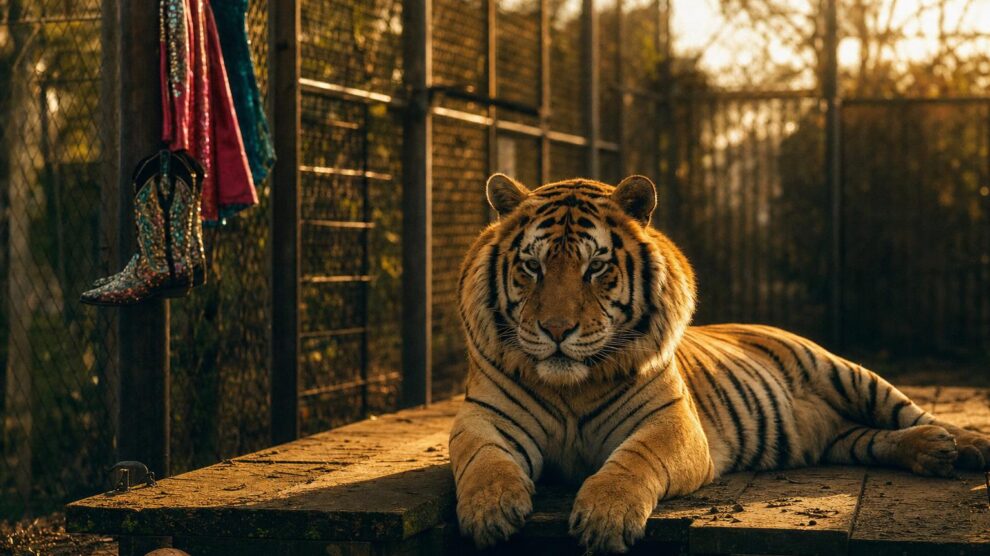
- Tiger King Joe Exotic (real name Joseph Allen Maldonado-Passage) is currently serving a 21-year federal prison sentence after being resentenced in January 2022 for murder-for-hire and wildlife trafficking charges.
- His health has been a major concern — Joe was diagnosed with prostate cancer that later progressed to what he described as “aggressive cancer,” leading to his transfer to a federal medical facility.
- The legal battles are far from over — Joe’s attorneys have pushed for a new trial, and his case continues to generate headlines years after the original Tiger King documentary took the world by storm.
- The Tiger King universe has expanded beyond Netflix — spinoffs, dramatic series, and new documentaries have kept the story alive on screen, with more content still in development.
- One update you might not expect: Joe Exotic announced a 2024 presidential run from prison — and it’s exactly as wild as it sounds. Keep reading for the full breakdown.
Tiger King Joe Exotic’s story refuses to end quietly. What started as a jaw-dropping Netflix documentary in March 2020 has turned into an ongoing legal and personal saga that just keeps delivering new twists.
For those catching up, Tiger King: Murder, Mayhem and Madness introduced the world to Joseph Allen Maldonado-Passage — a gun-toting, mullet-wearing big cat zoo owner from Oklahoma who became one of the most talked-about figures in recent pop culture history. The documentary’s wild ride through exotic animal ownership, bitter feuds, and alleged murder plots captivated millions of viewers practically overnight.
Joe Exotic Is Still Behind Bars — Here’s Where He Stands Today
As of the latest updates, Joe Exotic remains incarcerated in a federal facility. His sentence, currently set at 21 years, came after a long and complicated legal process that saw him convicted on serious federal charges. He was originally sentenced to 22 years in 2019, but a resentencing in January 2022 dropped that by one year — a minor win after years of legal fighting.
Eight Years In and Still Fighting His 21-Year Sentence
Joe has been behind bars since 2018, making this the eighth year of his imprisonment. His legal team has been persistent, filing motions and pushing for a new trial on the grounds that the original conviction was flawed. His attorneys have argued that the prosecution’s case had significant issues — claims the courts have yet to fully accept.
Here’s a quick breakdown of where his legal situation stands:
- Convicted in 2019 on two counts of murder-for-hire against Carole Baskin
- Also convicted on 17 federal charges related to wildlife trafficking and animal abuse
- Originally sentenced to 22 years, reduced to 21 years at resentencing in January 2022
- Attorneys have continued pushing for a new trial, citing issues with the original prosecution
- No new trial has been granted as of the latest available reporting
His Husband Was Deported — Joe Says He’s “Lost Everything”
Adding to Joe’s difficult situation behind bars, his husband Dillon Passage, whom he married while already in prison, has since moved on. The two separated, and in a more recent development, Joe married a fellow inmate named Seth Posey in a prison ceremony — a story that made headlines in 2024. Joe has spoken openly about feeling isolated and stripped of everything he once had, from his zoo and animals to his relationships and freedom.
The emotional toll has been a recurring theme in his communications from prison. Joe has sent letters, made media statements, and worked through his legal team to keep his name and story in the public eye — with varying degrees of success.
His Cancer Diagnosis and Move to a Federal Medical Facility
In May 2021, Joe Exotic announced he had been diagnosed with prostate cancer. Just months later, in November 2021, he revealed the diagnosis had advanced to what he described as “aggressive cancer.” The news raised immediate questions about whether he would receive adequate care inside a federal facility and whether his health could become grounds for early release or compassionate release consideration.
He was subsequently transferred to a federal medical center to receive treatment. His legal team used the cancer diagnosis as part of their argument during the resentencing process, citing his deteriorating health as a factor the court should weigh.
Key health-related developments in his case include:
- May 2021: Prostate cancer diagnosis announced publicly
- November 2021: Described cancer as having become “aggressive”
- Transferred to a federal medical facility for treatment
- Health used as a factor in resentencing arguments by his legal team
- No compassionate release has been granted as of the latest reporting
The Legal Battles That Never Seem to End
Joe Exotic’s legal history is layered and complicated. The charges against him went well beyond the murder-for-hire plot — prosecutors built a case that painted him as someone who repeatedly violated federal wildlife laws over many years at his Greater Wynnewood Exotic Animal Park in Oklahoma.
His attorneys have never stopped fighting. From appeals to motions for a new trial, the legal machinery around Joe Exotic has stayed active long after the cameras stopped rolling on the original Netflix documentary.
The Murder-for-Hire Conviction Against Carole Baskin Explained
The centerpiece of Joe’s criminal case was the murder-for-hire plot against Carole Baskin, owner of Big Cat Rescue in Tampa, Florida. The two had a feud that had been simmering for years before it boiled over into alleged criminal territory. Joe was convicted of hiring two separate individuals to kill Baskin — neither attempt succeeded, and both alleged hitmen ultimately cooperated with federal investigators.
The prosecution argued that Joe’s hatred for Baskin, fueled largely by her ongoing campaign to shut down his zoo and challenge his exotic animal practices, drove him to seek her death. The documentary captured the depth of this animosity vividly, with Joe making no secret of his contempt for her on camera.
The Endangered Animal Trafficking Charges That Added to His Case
The murder-for-hire charges were serious enough on their own, but the wildlife trafficking convictions added significant weight to Joe’s sentence. Federal prosecutors presented evidence that Joe had illegally sold tigers across state lines, falsified wildlife records, and violated the Endangered Species Act on multiple occasions. In total, he faced 17 federal charges related to wildlife crimes, and was convicted on all of them.
In 2022, prosecutors revealed additional details about the scale of the trafficking operation, describing it as a years-long pattern of abuse and illegal commerce involving endangered big cats. The charges included killing five tigers to make room for more animals, selling tiger cubs in violation of the Endangered Species Act, and falsifying federal wildlife records. These convictions, stacked on top of the murder-for-hire charges, made any path toward early release extremely difficult for his legal team to argue.
What Happened to the Tiger King Park
The Greater Wynnewood Exotic Animal Park in Wynnewood, Oklahoma was once home to hundreds of big cats, including tigers, lions, and ligers. At its peak, it was one of the largest privately owned big cat facilities in the United States, drawing thousands of visitors and generating significant revenue through cub petting experiences and roadside zoo operations.
When Joe was arrested and convicted, control of the park passed to Jeff Lowe, a Las Vegas businessman who had invested in the operation and became a central figure in Tiger King. Lowe’s management of the park quickly drew scrutiny from federal authorities and animal welfare organizations, and the facility’s condition deteriorated rapidly under his watch.
The park’s final days were as chaotic as everything else connected to the Tiger King story. Federal agencies and animal welfare groups intensified their pressure on Lowe, and the writing was on the wall for the facility long before it was officially shut down.
How the Zoo Was Seized and Shut Down
In 2021, the U.S. Department of Justice moved to seize the remaining animals at the Greater Wynnewood Exotic Animal Park following ongoing violations of the Animal Welfare Act and the Endangered Species Act under Jeff Lowe’s management. A federal judge ordered the transfer of the big cats after investigators documented a pattern of neglect and illegal activity at the facility.
Jeff Lowe had attempted to relocate operations to a new facility in Thackerville, Oklahoma, but federal authorities moved quickly to prevent the animals from simply being transferred to another problematic situation. The legal action against Lowe was swift and decisive.
- The U.S. DOJ filed a civil complaint against Jeff Lowe and his wife Lauren Lowe in 2021
- Federal agents seized 68 big cats from the Wynnewood facility
- A federal judge issued an order mandating the transfer of all animals to accredited sanctuaries
- The Thackerville facility Lowe was building was also targeted by federal action
- Jeff Lowe was effectively stripped of his ability to continue operating an exotic animal business
It was a decisive legal moment that marked the true end of the Greater Wynnewood Exotic Animal Park as a functioning operation — closing the chapter on a facility that had been at the center of controversy for well over a decade.
Where the Last of the Big Cats Ended Up
The 68 big cats seized from the park were transferred to accredited sanctuaries across the United States following the federal court order. The Wild Animal Sanctuary in Keenesburg, Colorado, one of the largest rescue facilities of its kind in the country, took in a significant number of the animals. The transfers were coordinated to ensure the cats received proper veterinary care, appropriate enclosures, and long-term welfare standards that had been severely lacking under both Joe Exotic and Jeff Lowe’s management.
Doc Antle’s Arrest and Release on Bond
Bhagavan “Doc” Antle, the eccentric big cat handler and founder of Myrtle Beach Safari in South Carolina, was one of the most memorable supporting characters in Tiger King. He presented himself as a legitimate wildlife expert while the documentary raised serious questions about his operation and lifestyle. Those questions eventually translated into formal criminal charges.
In 2021, Doc Antle was indicted in Virginia on charges of wildlife trafficking and conspiracy to launder money. The charges were connected to an alleged scheme involving the illegal sale of lion cubs. Antle was arrested, processed, and released on bond while awaiting trial — a development that many viewers who watched Tiger King felt was long overdue.
The Virginia case added another high-profile legal battle to the Tiger King universe, reinforcing the idea that the exotic animal industry in the United States was rife with illegal activity that extended far beyond Joe Exotic’s Oklahoma operation.
- Doc Antle was indicted in Virginia in 2021 on wildlife trafficking charges
- Charges included conspiracy to launder money connected to illegal cub sales
- He was arrested and released on bond pending trial
- His facility, Myrtle Beach Safari, remained open during legal proceedings
- The case drew renewed attention to the broader exotic animal trade in the United States
Carole Baskin’s Side of the Story
While Joe Exotic has remained the dominant figure in the Tiger King narrative, Carole Baskin has never stopped pushing back against how she was portrayed in the original Netflix documentary. As founder of Big Cat Rescue in Tampa, Florida, Baskin built her identity around animal advocacy — and she argues the documentary fundamentally distorted that image to make her look like a villain.
How Tiger King Made Her a Villain to Millions
The original Tiger King documentary dedicated significant screen time to the unresolved disappearance of Carole Baskin’s first husband, Don Lewis, who vanished in 1997 and was declared legally dead in 2002. The documentary presented the mystery in a way that strongly implied Baskin may have been involved in his disappearance — an implication that ignited a firestorm of public hatred toward her almost immediately after the show dropped on Netflix in March 2020.
Almost overnight, Baskin became the internet’s most hated woman. Memes, threats, and a torrent of online abuse flooded in from viewers who had taken the documentary’s framing at face value. Her organization Big Cat Rescue was bombarded with negative attention, and she received credible death threats that required increased security at her sanctuary. The public response was so intense that it overshadowed the genuine advocacy work she had been doing for decades.
Carole Baskin on the documentary: “I feel like I was set up. The directors told me it would be a documentary about the abuse of big cats in America. Had I known it was going to be like it was, I would never have participated.”
Baskin has since been vocal about her belief that the filmmakers deliberately misrepresented her to create a more dramatic narrative. She participated in follow-up content specifically to correct the record, and has been consistent in maintaining her innocence regarding Don Lewis’s disappearance. Despite her efforts, the villain label has proven extremely difficult to shake — a reality she openly acknowledges in interviews.
What She Says the Documentary Got Wrong
Baskin’s core complaint about Tiger King is that it was sold to her as a documentary about big cat abuse, not a character assassination piece. She argues that the filmmakers selectively edited footage and deliberately framed the Don Lewis story to cast suspicion on her without any factual basis. She has pointed out that law enforcement investigated her thoroughly following Lewis’s disappearance and never charged her with any crime. To this day, no evidence has emerged connecting her to his disappearance.
She has also pushed back against the suggestion that Big Cat Rescue operates in any way similar to Joe Exotic’s zoo. Unlike roadside zoos that profited from cub petting and public handling of animals, Big Cat Rescue maintained accreditation standards and actively lobbied for the Big Cat Public Safety Act — federal legislation that was eventually signed into law in December 2022, effectively banning private ownership of big cats and public cub handling across the United States. That law represented the culmination of years of work that Baskin considers her most significant legacy.
Tiger King on Screen: Documentaries, Spinoffs, and What’s Next
The original Tiger King documentary was a cultural phenomenon unlike almost anything Netflix had produced before it. Dropping in March 2020 just as global lockdowns were beginning, it became appointment viewing for a world with nowhere to go and nothing but time. Within its first month, it had been watched by over 34 million households in the United States alone, according to Netflix figures released at the time.
That kind of audience didn’t just disappear when the credits rolled. It created an ecosystem of follow-up content — some authorized, some not — that has kept the Tiger King story alive on screen for years after the original documentary aired.
Tiger King 2 on Netflix: What Critics Said
Netflix released Tiger King 2 in November 2021, bringing back directors Eric Goode and Rebecca Chaiklin for another look at the exotic animal world. The five-episode follow-up dug into new developments including Jeff Lowe’s legal troubles, fresh perspectives on the Don Lewis disappearance, and updates on the key players from the first documentary. Notably, Joe Exotic did not cooperate directly with the production, which left a significant gap in the narrative that the filmmakers struggled to fill.
Critical reception was decidedly mixed. Many reviewers felt that Tiger King 2 lacked the explosive, almost unbelievable energy of the original — largely because the first documentary had the advantage of introducing these characters cold. By the time the sequel arrived, audiences already knew the players. Without that shock factor, the follow-up felt more like an extended update than a compelling standalone documentary. Still, it drew a substantial audience simply on the strength of the brand.
Joe vs Carole: The Dramatic Series Inspired by the Story
Peacock took a different approach to the Tiger King story, adapting it into a scripted dramatic series called Joe vs Carole, which premiered in March 2022. John Cameron Mitchell played Joe Exotic and Kate McKinnon took on the role of Carole Baskin in a dramatized retelling of the feud that centered the story more on character psychology than sensational facts. The series was based on the Wondery podcast Over My Dead Body: Joe Exotic, which had already explored the story in substantial depth. Reception was lukewarm, with critics acknowledging strong performances but questioning whether dramatizing a story still unfolding in real life added meaningful value.
The New Tiger King Series Still in the Works
Beyond what has already aired, additional Tiger King content has been reported as being in various stages of development. Louis Theroux, the British documentary filmmaker known for embedding himself in fringe communities, filmed content with Joe Exotic and described him as being in “an extraordinary situation.” Theroux’s involvement generated significant interest given his track record with complex, morally layered subjects.
The appetite for Tiger King content appears to remain strong among streaming platforms, even as the key figures in the story have faded slightly from the cultural foreground. As long as Joe Exotic remains in prison and his legal battles continue generating headlines, the story has enough live material to sustain further documentary exploration.
Joe Exotic Announced a 2024 Presidential Run From Prison
In what can only be described as a perfectly on-brand move, Joe Exotic announced his intention to run for President of the United States in 2024 — all from inside a federal prison cell. He made the announcement through his legal team and social media channels managed on his behalf, framing his candidacy around criminal justice reform and personal freedom. While the campaign had no realistic path to the ballot given his felony convictions, it served its purpose as a media moment, generating significant coverage and keeping his name in circulation.
It was far from his first political venture. Joe had previously run for Governor of Oklahoma in 2018 as a Libertarian candidate, receiving around 664 votes — less than 1% of the total. He had also run for President before in 2016. The 2024 announcement followed the same pattern: maximum publicity, minimum political viability, and an unmistakable flair for theater that has always defined his public persona.
The Tiger King Saga Is Far From Over
Eight years into a 21-year sentence, Joe Exotic is still fighting. His legal team continues to push for relief, his health remains a complicating factor, and his ability to generate headlines from inside a federal medical facility is, somehow, undiminished. The man who built a mullet-and-tigers empire in rural Oklahoma has managed to remain a relevant cultural figure long after most people assumed the story had run its course.
The broader world the documentary exposed has also changed significantly. The Big Cat Public Safety Act, signed into law in December 2022, stands as perhaps the most meaningful real-world consequence of the Tiger King phenomenon — legislation that effectively ended the roadside zoo cub-petting industry that figures like Joe Exotic and Doc Antle had built their operations around. Jeff Lowe lost his animals. Doc Antle faced federal charges. The industry at the center of the documentary has been fundamentally disrupted.
Carole Baskin, for her part, got the legislation she had spent decades fighting for — even if she had to survive a global wave of public hatred to get there. She continues to operate Big Cat Rescue and remains active in animal advocacy, largely on her own terms now that the worst of the post-documentary attention has subsided.
What makes the Tiger King story so persistently compelling is that it refuses to resolve neatly. Joe maintains his innocence. The courts have not budged on his sentence. His health is uncertain. A new marriage has been announced from inside prison walls. The animals are gone, the zoo is gone, and the era of big cat roadside attractions in America is functionally over — but the human drama continues to generate new chapters at a pace that feels almost scripted.