






- Paul Revere’s fame owes more to an 1861 poem than to the actual events of April 18, 1775.
- At least four other riders — including a teenage girl — played equally critical roles in warning the colonists that night.
- Revere was actually captured by the British during his ride and never made it to Concord.
- Henry Wadsworth Longfellow deliberately altered key facts to craft a more dramatic, singular hero story.
- The real warning network that night was a coordinated system — not the work of one lone patriot on horseback.
Paul Revere didn’t become an American legend because of what he did — he became one because of what a poet wrote about him 86 years later.
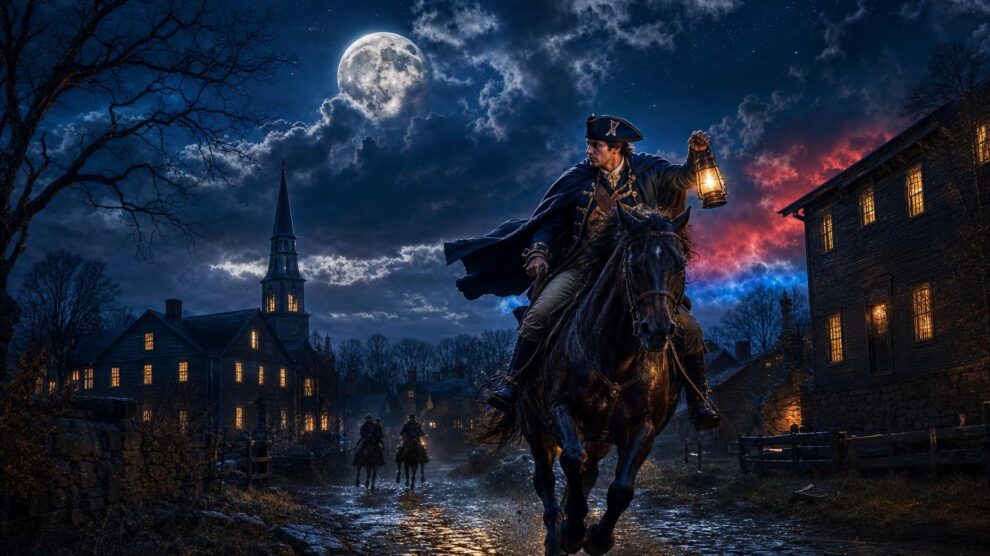
Most Americans picture the same scene: a lone rider thundering through the dark Massachusetts countryside, lantern light flickering, shouting that the British were coming. That image is almost entirely the creation of Henry Wadsworth Longfellow. The real story of April 18, 1775 is messier, more coordinated, and far more interesting than any poem could capture. For anyone passionate about American history, understanding how Paul Revere’s legend was built — and what it obscures — is essential reading.
The Paul Revere House in Boston remains one of the best primary sources for separating the man from the myth, preserving his own written accounts of that night alongside the historical context that textbooks frequently leave out.
Midnight Ride at a Glance
Before diving into the myth-making, here’s a quick breakdown of what actually happened on the night of April 18, 1775 versus what most people believe:
The Legend The Historical Record Paul Revere rode alone to warn the colonies At least five riders carried the warning that night and in the days following He shouted “The British are coming!” He likely said “The Regulars are out” — colonists still considered themselves British He completed his mission to Concord He was captured by a British patrol before reaching Concord The lanterns in the church steeple were his signal to ride The lanterns were a signal for others in Charlestown — Revere had already left Boston Longfellow’s poem is historically accurate Longfellow admitted to altering facts for poetic effect
The gap between legend and reality isn’t a small one. It’s the difference between a carefully coordinated colonial intelligence operation and a single heroic horseman — and understanding that gap is what makes the true story so compelling.
One Poem Changed How America Remembers April 18, 1775
For 86 years after the midnight ride, Paul Revere was a respected Boston silversmith and patriot — but not a household name. That changed completely in 1861 when Henry Wadsworth Longfellow published Paul Revere’s Ride in The Atlantic Monthly. The timing was deliberate. The country was fracturing at the start of the Civil War, and Longfellow wanted to remind Americans of a time when patriots stood up against overwhelming force. For more on the other riders involved, you can read about Paul Revere’s other riders.
The poem exploded in popularity almost immediately. It was memorized in schoolrooms, recited at public gatherings, and reprinted endlessly. Within a generation, its version of events had replaced the historical record in the minds of most Americans. The legend wasn’t just born — it was institutionalized.
How Longfellow Turned Revere Into a Legend
Longfellow’s genius was in simplification. He took a complicated, multi-person operation and reduced it to one man, one horse, and one night of heroism. The famous opening lines — “Listen, my children, and you shall hear / Of the midnight ride of Paul Revere” — created an instant emotional connection. By the time a reader reached the end of the poem, Revere wasn’t just a messenger. He was the symbol of American resistance itself.
What the Poem Got Wrong About That Night
The factual errors in Longfellow’s poem aren’t minor slip-ups — they fundamentally misrepresent how the warning system worked. The most cited error involves the signal lanterns hung in the steeple of Christ Church (Old North Church). Longfellow wrote as if Revere was waiting to receive that signal before riding. In reality, Revere had already arranged for the lanterns to be displayed as a signal to patriots waiting in Charlestown, in case he himself couldn’t get out of Boston. He had already crossed the Charles River by the time the lanterns were lit.
The poem also erases William Dawes entirely — a rider who left Boston the same night via a different route — and makes no mention of Samuel Prescott, who was the only rider to actually reach Concord with the warning. These weren’t minor characters. Without them, the mission fails.
Why Fiction Became Accepted as Fact in Classrooms
The answer is simpler than most historians like to admit: the poem was just better storytelling. A lone hero is easier to teach, easier to remember, and easier to celebrate than a coordinated intelligence network. American education in the 19th and early 20th centuries leaned heavily on patriotic mythology, and Longfellow’s Revere fit perfectly into that tradition. By the time academic historians began pushing back on the narrative, the poem had already been embedded in three or four generations of American memory.
The Other Riders History Forgot
The truth is that the warning system on the night of April 18, 1775 depended on multiple riders working in parallel. Paul Revere was one part of a carefully organized patriot intelligence network — not a lone wolf acting on instinct. At least four other individuals rode that night and in the days that followed, each covering critical ground that Revere himself could not.
William Dawes: The Rider Who Took the Southern Route
William Dawes rode out of Boston the same night as Paul Revere, but took the longer southern route across the Boston Neck — the only land connection between Boston and the mainland. Where Revere crossed the Charles River by boat, Dawes talked his way past British sentries on foot, likely disguised as a farmer or laborer. It was a dangerous bluff that required nerves of steel, and it worked. Learn more about Paul Revere’s other riders and their contributions to the historic night.
Dawes and Revere actually met up in Lexington, where both men warned Samuel Adams and John Hancock that British Regulars were on the march. Together, they then set out toward Concord — until a British patrol intercepted them. Dawes escaped by turning his horse and galloping back toward Lexington, but in the chaos, his horse threw him and he was left stranded on foot. He never resumed the ride.
History’s treatment of Dawes is almost poetically ironic. A poem written decades after his death by a man named H.W. Longfellow of all people immortalized Revere, while Dawes — who took the harder, riskier route — was completely omitted. Even a later poet named Charles Ferris Gettemy lamented this in verse, noting that Dawes rode just as boldly but drew the short straw of historical memory simply because his name didn’t rhyme as well. For more on this, you can read about the real story of Paul Revere’s ride.
“Tis all very well for the children to hear of the midnight ride of Paul Revere; but why should my name be quite forgot, who rode as boldly and well, God wot?”
— From a poem referencing William Dawes, highlighting the arbitrary nature of his historical erasureDespite being written out of the popular narrative, Dawes’s contribution was essential. Without his southern route ride, the warning to Lexington depended entirely on Revere making it through — and Revere himself acknowledged Dawes’s role in his own written accounts of that night.
Samuel Prescott: The Only Rider Who Reached Concord
Samuel Prescott is arguably the most important rider of the three who set out toward Concord that night — and almost no one knows his name. A young doctor from Concord who happened to be in Lexington that evening, Prescott joined Revere and Dawes on the road to Concord. When the British patrol ambushed the group, Prescott jumped his horse over a stone wall and cut across open fields, successfully evading capture. He was the only one of the three riders who actually delivered the warning to Concord, which gave the militia there time to hide their military supplies before the British arrived. Without Prescott, the entire purpose of the ride — protecting the weapons cache at Concord — would have failed.
Sybil Ludington: The Teenage Rider Who Covered Twice the Distance
Two years after the midnight ride, on the night of April 26, 1777, a 16-year-old girl named Sybil Ludington rode approximately 40 miles through Putnam County, New York — nearly twice the distance Revere covered — to rally her father’s militia regiment after British forces burned Danbury, Connecticut. Riding alone through the dark, rainy night on a horse named Star, she knocked on farmhouse doors with a stick to rouse sleeping militiamen. Her father, Colonel Henry Ludington, needed someone to call his 400 men to arms, and Sybil volunteered. By dawn, enough soldiers had assembled to march toward Danbury. She received personal thanks from General George Washington for her effort, yet remains a footnote in most American history curricula.
Israel Bissell: The Rider Who Spread the News for Four Days
If any rider deserves more recognition than Paul Revere, the case could be made for Israel Bissell. Beginning on April 19, 1775 — the morning after Revere’s ride — Bissell carried an express message about the battles at Lexington and Concord all the way from Watertown, Massachusetts to Philadelphia, Pennsylvania. He covered the distance over approximately four days, riding through Connecticut, New York, and New Jersey, spreading the news of the opening shots of the American Revolution to colonies far beyond Massachusetts.
Bissell wasn’t making a single dramatic night ride — he was sustaining a relay of information across hundreds of miles that transformed a local skirmish into a continental crisis. His ride helped turn public opinion in the middle colonies toward supporting armed resistance, which was arguably more strategically significant than warning two men in Lexington.
Yet Bissell never got a poem. He never got a statue in a major city. His name never made it into school textbooks. The same arbitrary machinery of historical memory that elevated Revere simply never turned its attention to Bissell — and the story of American independence is poorer for it.
What Paul Revere Actually Did That Night
Setting the myth aside entirely, what Paul Revere actually did on April 18, 1775 was still remarkable — just different from the legend. He was a skilled, experienced messenger operating within a sophisticated patriot intelligence network. He didn’t act alone or on impulse. His ride was the result of careful planning, trusted relationships, and years of service to the colonial cause. Understanding what he actually did makes him more impressive as a historical figure, not less.
His Role as a Professional Messenger Before the Ride
By 1775, Paul Revere had already established himself as one of the most trusted express riders in the patriot movement. In the years leading up to the midnight ride, he had made multiple long-distance journeys on behalf of the Sons of Liberty and the Boston Committee of Correspondence — including a ride to Philadelphia and back in 1774 to deliver the Boston Port Bill news to the Continental Congress. He wasn’t chosen for the April 18 mission because he happened to own a fast horse. He was chosen because he was a proven, reliable operator in a network that colonial leaders depended on for their lives.
The Network of People Behind the Warning System
Paul Revere didn’t wake up on April 18, 1775 and spontaneously decide to ride. The warning system that night was the product of weeks of careful organizing by the Sons of Liberty and the Boston Committee of Safety. Revere himself had set up a network of scouts and informants inside Boston to monitor British troop movements — and it was one of those informants who tipped him off that the Regulars were preparing to march that very night.
The signal lanterns at Christ Church were just one piece of a layered communication plan. Revere had arranged with patriot leader Joseph Warren and sexton Robert Newman to hang either one or two lanterns in the steeple — one if the British were marching out by land over Boston Neck, two if they were crossing the Charles River by boat. This wasn’t improvisation. It was a pre-planned redundancy built into the system specifically in case Revere was captured before he could deliver the warning in person.
The network extended far beyond Boston. Patriot riders and militiamen along the routes to Lexington and Concord were already primed to receive and relay warnings. When Revere arrived in towns along his route, local alarm systems kicked in almost immediately — church bells rang, drummers beat their drums, and militia captains began assembling their men. Revere was the trigger, not the entire mechanism.
Where Revere’s Ride Actually Ended
Most Americans assume Revere completed his mission and rode triumphantly into Concord. The reality is far more abrupt. Somewhere on the road between Lexington and Concord, Revere, Dawes, and Prescott rode directly into a British patrol of approximately four officers. Revere was seized and held at gunpoint. He was interrogated about his activities and told the British officer — quite boldly — exactly what he had been doing, warning the countryside that the Regulars were on the march.
The British eventually released Revere, but they took his horse. He walked back to Lexington on foot, arriving just in time to witness the opening confrontation on Lexington Green from a distance. His riding mission was over. The man immortalized for his ride didn’t even finish it — and yet his warning had already done its job. Lexington’s militia had assembled, Adams and Hancock had fled to safety, and Samuel Prescott had carried the message forward to Concord.
Rider Route Outcome Distance Covered Paul Revere Charlestown to Lexington Captured by British patrol; horse confiscated ~13 miles William Dawes Boston Neck to Lexington Escaped patrol; thrown from horse, did not continue ~17 miles Samuel Prescott Lexington to Concord Evaded patrol; successfully delivered warning ~6 miles from pickup point Israel Bissell Watertown, MA to Philadelphia, PA Successfully completed full relay ~345 miles over 4 days Sybil Ludington Putnam County, NY circuit Successfully rallied militia regiment ~40 miles What the table above makes painfully clear is that measured purely by mission completion, Revere was the least successful of the five riders. He covered the shortest distance, was the only one actively captured, and never delivered the warning to Concord. Yet he received virtually all of the historical credit. The disconnect between performance and recognition is one of the most striking examples of how mythology overrides documented history.
Revere himself never claimed sole credit for the night’s events. In his own written accounts — preserved today at the Massachusetts Historical Society — he matter-of-factly described the roles of Dawes, Prescott, and the broader warning network. The myth wasn’t his creation. It was Longfellow’s.
Why Revere’s Name Stuck While Others Faded
Understanding why Paul Revere became the face of the midnight ride requires looking at both who he already was before 1775 and how historical memory gets manufactured over time. The answer combines pre-existing fame, the power of poetry, and the specific moment in American history when Longfellow chose to publish his poem.
His Pre-existing Fame as a Boston Silversmith and Patriot
By the time of the midnight ride, Paul Revere was already one of Boston’s most recognizable figures. His silverwork was prized throughout the colonies — pieces crafted in his shop on Clark’s Wharf were symbols of both artisanal excellence and colonial identity. More critically, he was a prominent member of the Sons of Liberty and had already gained notoriety through his 1770 engraving of the Boston Massacre, which became one of the most widely distributed pieces of political propaganda in colonial America. Revere wasn’t just a messenger — he was already a public figure with an established name and reputation. When Longfellow needed a hero whose name would resonate with readers, Revere was the obvious choice. Dawes and Prescott were capable patriots, but they had no equivalent public profile to attach a legend to.
The 86-Year Gap Between the Ride and Longfellow’s Poem
Longfellow published Paul Revere’s Ride in January 1861 — on the eve of the Civil War — and the timing shaped everything about how the poem was received. America desperately needed unifying heroes, and Longfellow gave the country one. The 86-year gap between the actual event and the poem meant that most primary witnesses were long dead, written records were scattered, and the general public had no competing narrative deeply embedded in their memory. The field was wide open for Longfellow’s version to take root. Once it did — taught in schools, reprinted in newspapers, recited at civic events — it became nearly impossible to dislodge. Historical correction rarely wins against beloved poetry, especially when the poetry has had a century’s head start.
The Real Story Is More Impressive Than the Legend
Here’s what the Longfellow myth accidentally obscures: the actual events of April 18, 1775 represent something far more remarkable than a lone hero on horseback. What the colonial patriots built was a functioning, pre-planned intelligence and communication network capable of mobilizing armed resistance across dozens of miles within a matter of hours — in the dark, in secret, against a professional military force. That is an extraordinary organizational achievement for any era, let alone the 18th century.
Revere, Dawes, Prescott, Bissell, and Ludington weren’t acting as isolated individuals driven by personal heroism. They were nodes in a system — trusted, trained, and committed to a shared cause larger than any one of them. The Sons of Liberty and the Committee of Safety had spent years building the relationships, establishing the routes, and developing the signal systems that made a rapid coordinated response possible. The midnight ride didn’t happen because one man was brave enough to ride. It happened because dozens of people were organized enough to make it work.
The legend of Paul Revere deserves to be expanded, not discarded. Every American history enthusiast who learns the full story gains something that the simplified myth can never offer: a genuine appreciation for the collective courage, intelligence, and preparation that actually ignited the American Revolution. The real heroes of April 18, 1775 weren’t riding alone through the dark. They were part of something bigger — and that is a story worth telling in full.
For a deeper look into the founding era and the real figures who shaped American independence, the Paul Revere House offers primary source materials, interactive maps of the midnight rides, and Revere’s own handwritten accounts that bring the authentic history to life.


